
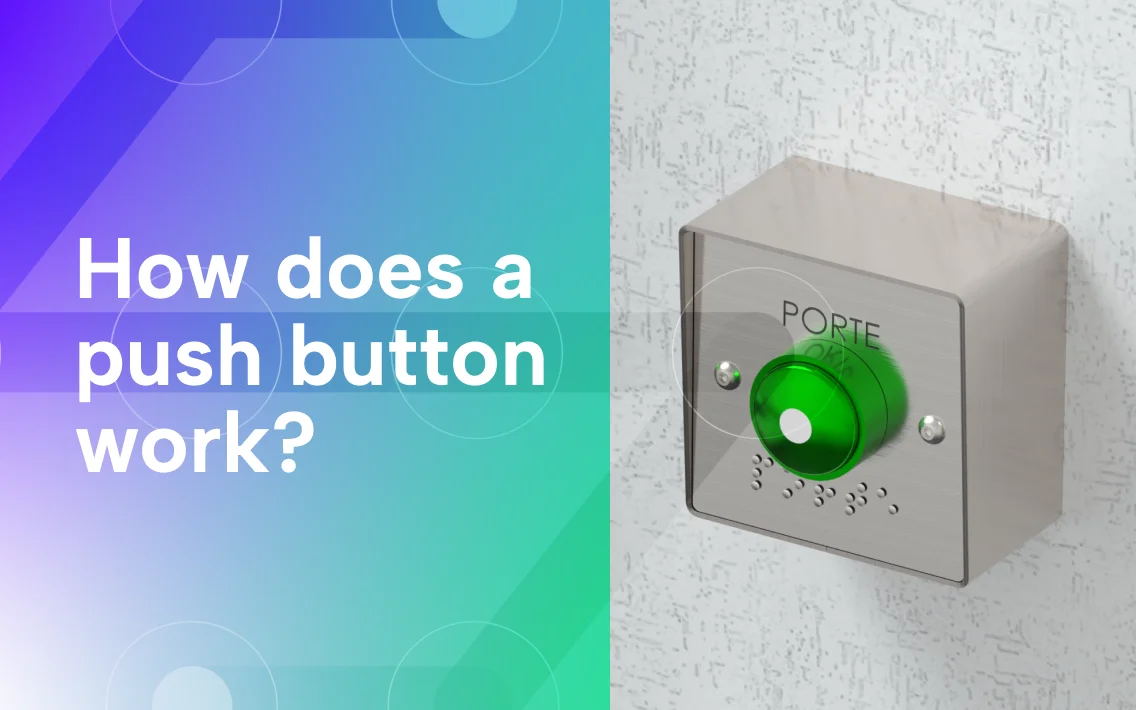
In an access-control installation, the humble push button plays a deceptively simple but essential role. Whether you’re unlocking a door, triggering an emergency exit device, or integrating into a fully-featured system, understanding how a push button works ensures you choose the right model and wiring for your application.
What is a push button?
A push button is an activation device that closes or opens an electrical circuit when pressed. In the context of access control, it’s typically used to command an electromagnetic handle, an electric strike, or another locking mechanism from the secure side. Whether in a stand-alone access control setup or part of a centralised access control system, the push button serves as the human interface.
Key technical functions of a push button
Normally Open (NO) vs Normally Closed (NC) contacts
- NO (Normally Open): The circuit is open until the button is pressed, then it closes and activates the command.
- NC (Normally Closed): The circuit is closed until the button is pressed, then it opens. This is often used in safety or emergency exit modes.
Indicator lights and combined functions
Many models come with green/white LED indicators, built-in timers or buzzer functionality. These are particularly useful in public buildings or PRM (persons with reduced mobility) installations where clear visual feedback is required.
Mounting types and environments
Push buttons can be surface-mounted or flush-mounted, in stainless steel, ABS or infrared models. SEWOSY’s range includes: stainless-steel finish, PRM-compliant format, ABS economical versions and infrared-activated models.
Choosing the right push button for your project
Here are some considerations when selecting a push button:
- Finish and material: Stainless steel provides high durability and aesthetic alignment with premium hardware; ABS is cost-effective for standard installations.
- Contact configuration: Decide NO or NC depending on whether the push button will trigger a locking device or interrupt it.
- Indicator/feedback: For high-traffic areas or accessibility requirements, choose models with LED indicators or buzzer feedback.
- Wiring and voltage: Many SEWOSY push buttons support 12/24V AC/DC and come with screw terminals or pre-wired leads.
- Compliance & accessibility: Ensure the chosen push button complies with local codes regarding accessibility and emergency egress.
Typical applications of push buttons
- Behind a reception desk controlling a main entrance with a stand-alone access control module.
- In a corridor door linked to a centralised access control system that logs each activation.
- Next to an emergency exit where the push button deactivates an electromagnetic handle or electric strike to allow egress.
Installation best practices
- Mount the push button at a standard height (typically around 1050 mm from floor for general access, lower if PRM) so it is easily reachable.
- Use clear labeling (e.g., “PUSH TO EXIT”) or colour contrast for safety and usability.
- Connect the NO/NC contacts according to the locking device specification: some electric strikes require a break of current (NC) to release, others a make of current (NO).
- Test the button after installation to verify that the correct circuit is triggered and feedback (LED, buzzer) functions as expected.